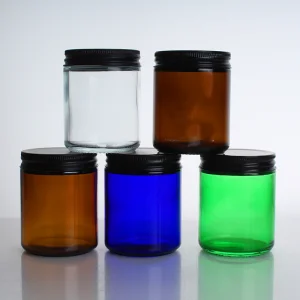
Executive Whitepaper: Industrial Sourcing of High-Performance Glass Candle Jars in Central Africa
The manufacturing and deployment of luxury glass candle jars in Equatorial Guinea represent an emerging nexus between consumer market expansion and regional industrial supply chain evolution. Historically reliant on imported, fully finished lifestyle products, the markets of Malabo (Bioko Island) and Bata (mainland region) are transitioning towards localized value addition. Local businesses, high-end hospitality hubs (such as the luxury resorts in Sipopo), and boutique cosmetic brands are shifting to sourcing raw components. Among these components, high-specification glass containers stand as the critical primary packaging element.
1. Demographic and Macroeconomic Drivers in Equatorial Guinea
Equatorial Guinea possesses a unique economic structure within the CEMAC (Central African Economic and Monetary Community) region. Supported by extensive energy resources, the country has achieved high per-capita GDP relative to the continental average, creating a highly demanding consumer segment concentrated in key municipal cores. The growing middle and upper classes demand high-end homeware, aromatherapy, and wellness products. Furthermore, the expansion of five-star hospitality infrastructures—hosting diplomatic delegations and eco-tourists—has driven the operational need for bespoke, premium candles that reflect the local cultural heritage, tropical botanical profiles, and national brand identity.
500°C+
Thermal Shock Rating
Zero-Lead
100% Recyclable Glass
ISO 9001
Manufacturing Standard
100%
AQL Pass Rate
2. Solving Tropical Environmental Challenges for Premium Candle Jars
Operating a candle-pouring facility or utilizing scented candles in Equatorial Guinea presents severe environmental hurdles that standard glass containers cannot survive. The country experiences a hot, humid equatorial climate with average relative humidity levels consistently exceeding 80–90%. Under these conditions, the physical and chemical interactions between glass, fragrance oils, and natural waxes (such as soy, coconut, or beeswax) change dramatically:
Hydrolytic Degradation: Cheap, low-quality glass can suffer from chemical weathering (glass disease) in high humidity. Water vapor reacts with surface alkali ions, clouding the glass and weakening its structure. Guangzhou Bogart Glass utilizes high-grade soda-lime silica and borosilicate blends containing optimal silica levels to ensure a hydrolytic class III rating or higher.
Thermal Stress Resistance: The ambient high temperatures in coastal areas like Bata place structural stress on candle jars. When a candle is lit, the interior temperature of the molten wax pool can reach 60°C to 80°C. If the glass thickness is inconsistent, or if internal stresses are present due to poor annealing, the high temperature gradient between the interior and ambient room temperature can cause thermal fractures. Our jars are annealed under computer-controlled thermal tunnels to guarantee zero residual stress.
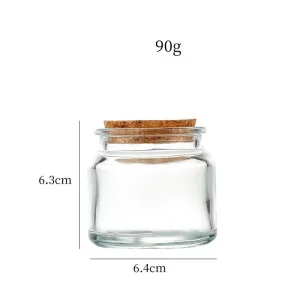
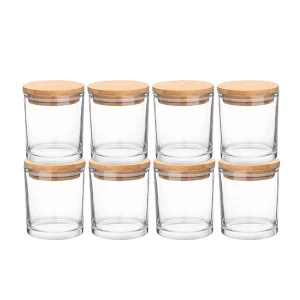
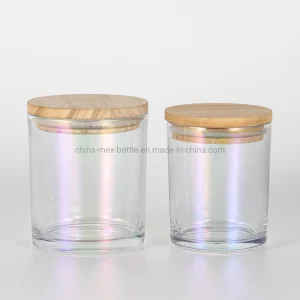
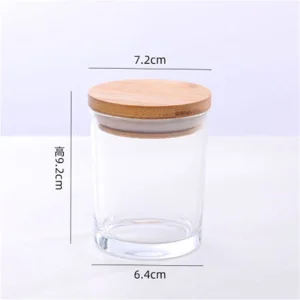
Hermetic Seal Systems: High humidity accelerates the evaporation of volatile essential oils in candles. Our glass candle containers are custom-fit with high-density bamboo, metal, or cork lids featuring food-grade silicone rings. These prevent fragrance syneresis (sweating) and preserve the scent throw over long transit and shelf-life periods.
3. Global Manufacturing Technologies Applied to Local Demands
At our state-of-the-art production facility at Guangzhou Bogart Glass Products Co., Ltd, we bridge the gap between global advanced engineering and the specific customization needs of African buyers. Our processes include:
Precision Melting Furnaces: Operating at temperatures up to 1600°C, our melting systems guarantee complete homogeneity of raw glass components. This removes micro-bubbles and impurities that could cause visual distortion or structural weak points.
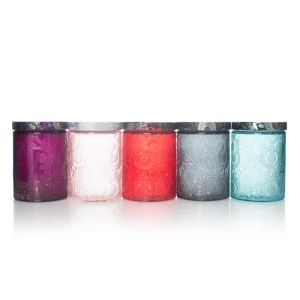
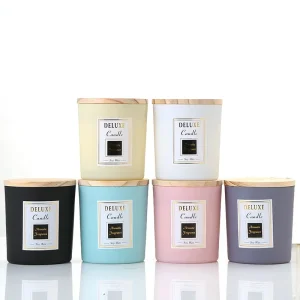
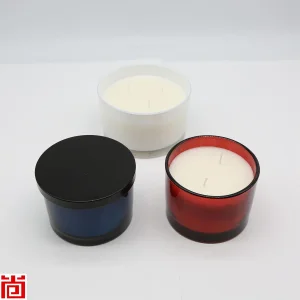
Surface Decoration Capabilities: We offer advanced post-processing technologies including high and low-temperature silk screen printing, matte spray painting (organic and ceramic-based), hot stamping silver/gold, precision acid frosting, and metallic electroplating. These permit local brands in Bata and Malabo to achieve the same aesthetic standards as luxury European brands.
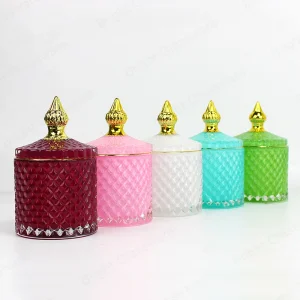
Integrated CAD/CAM Engineering: Custom structural shapes—ranging from geometric diamond-cut patterns to clean, minimalist Scandinavian-style cylinders—can be prototyped and molded within 15–20 days. This allows businesses in Equatorial Guinea to build unique, recognizable brand assets.
Custom Mold Engineering
Full 3D modeling and custom mold creation tailored to unique capacity metrics (2oz to 24oz) ensuring distinct market positioning.
Rigorous Quality Auditing
Visual polariscope testing, thermal shock testing up to 90°C differentials, and vertical load resistance tests on every production batch.
Eco-Conscious Materials
Lead-free formulation compatible with natural soy, coconut, and beeswax mixtures, preserving ambient indoor air quality.
Importing raw materials into West-Central Africa requires navigating complex logistics and customs landscapes. Our dedicated foreign trade logistics department streamlines shipments to major ports in Equatorial Guinea:
Port of Malabo (Bioko Island): Suitable for fast distribution to the insular region, high-end hotel chains, and local capital retail centers. We provide detailed BL (Bill of Lading), Certificate of Origin, and packing lists to expedite customs clearance.
Port of Bata: The optimal entry point for distribution inland and to neighboring CEMAC countries like Cameroon and Gabon. We arrange container loading to withstand maritime moisture and long-distance truck transport.
Protective Packaging Protocols: Standard corrugated packaging is vulnerable to collapsing in humid tropical transits. Bogart Glass uses reinforced, double-wall corrugated cartons with customized cell dividers. Pallets are completely shrink-wrapped and layered with desiccants to control moisture levels inside the container, eliminating mold growth on wood or bamboo lids.
The global beauty and home fragrance industries are moving rapidly towards circular economies. Our technological roadmap includes lightweighting glass containers to reduce the carbon footprint during transport without compromising structural strength. We are also increasing the percentage of cullet (recycled glass raw material) in our furnaces. This lowers melting energy requirements and reduces emissions, aligning our production with global sustainability goals.
What is the Minimum Order Quantity (MOQ) for shipping to Equatorial Guinea?
For standard shapes and in-stock glass candle jars, our MOQ starts at 5,000 units. For fully customized structures, unique colors, or custom logo embossing, the MOQ typically ranges from 10,000 to 20,000 units, depending on the complexity of the design and mold requirements.
How do you prevent bamboo and wooden lids from molding during transport to West Africa?
We subject all bamboo and wood lids to a specialized fumigation and drying process to reduce moisture content below 8%. We then coat the lids with a food-grade, anti-microbial protective lacquer. During packing, moisture-absorbing silica gel packs are added directly inside the cartons, and container-wide dehumidifier bags are placed inside the shipping containers to prevent mold growth during maritime transit.
Are your glass containers certified for thermal shock resistance?
Yes, our glass candle jars comply with ASTM thermal shock standards. They are engineered to withstand sudden temperature changes up to 90°C (162°F) without cracking. This ensures the safety of the end-user during candle combustion and prevents wax leaks or catastrophic failures.
What decoration options are best for high-humidity climates?
We recommend high-temperature ceramic silk screen printing and physical vapor deposition (PVD) electroplating. High-temperature printing fuses the ink directly into the glass structure, preventing peeling or scratching. PVD electroplating resists oxidative corrosion caused by high salt spray and humidity levels in coastal areas like Bata.


 Bogart Glass