Sourcing premium Grolsch glass bottles requires deep insight into glass chemical resistance, thermal mechanical tolerances, and gasket elasticity standards. Discover how international enterprise buyers audit top factories to optimize product freshness and extend shelf life.
Authentic Grolsch swing-top designs are engineered for pressurized environments. Standard fermentation processes demand bottle integrity that withstands up to 10-12 bar. Advanced factories employ finite element analysis (FEA) to reinforce structural stress points around the neck and base.
Superior sealing depends directly on gasket material. While lower-tier manufacturers use traditional vulcanized rubber, top-tier factories utilize FDA-approved, BPA-free food-grade silicone (VMQ) or thermoplastic elastomers (TPE). These compound polymers maintain long-term elasticity and prevent oxygen ingress.
Consistency in soda-lime-silica composition determines both bottle clarity and structural integrity. A high percentage of pure silica (SiO₂), coupled with strict annealing curves (cooling patterns in the annealing lehr), prevents micro-fracturing and ensures thermal shock resistance of at least 40°C.

Comprehensive Glass Packaging Development, Research, Production & Global Sales
Bogart Glass is an integrated enterprise focused on modern design and high-volume manufacturing. Originally established to serve the premium cosmetic and chemical reagent sectors, Bogart has built a legacy of technical excellence in glass melting, processing, and finishing.
Expanded from localized glass manufacturing into advanced cosmetic glass bottle production. By optimizing processes such as high and low-temperature silk screen printing and sanding, Bogart solidified its foothold in regional distribution channels through rigorous quality control.
Achieved breakthroughs in hot stamping/silver stamping and innovative chemical etching. Bogart established its foreign trade branch in Guangzhou, directly participating in international exhibitions to serve global brands across North America, Europe, and Asia-Pacific.
Operating from modern production facilities with rigorous management standards, Bogart Glass blends technical craftsmanship with volume scalability.
| Operations Pillar | Technical Capability & Procurement Safeguards |
|---|---|
| Production Equipment | Advanced glass melting furnaces deliver high-volume, continuous molten glass daily, supporting automated high-speed forming machines and uniform wall thickness. |
| Quality Control (QA/QC) | Stringent raw material testing for purity, mechanical stress tests on finished items, and strict dimensional verification to control defect ratios from batching to packaging. |
| Research & Innovation | An active materials science and design team dedicated to developing light-blocking properties, custom closures, and unique structural glass geometries. |
| Environmental Protection | Investment in energy-efficient kilns, electric booster melting systems, and waste heat recovery to reduce greenhouse gas emissions and assist client ESG compliance. |
| After-Sales Support | Comprehensive customer resolution system, offering custom transit damage guarantees, prompt technical consultation, and global logistical support. |
Sustainable sourcing has transformed the global glass industry. Environmental regulations and rising shipping costs are driving the adoption of "lightweight" glass designs. By optimizing the distribution of molten glass within the mold using advanced Blow-and-Blow or Narrow Neck Press-and-Blow (NNPB) processes, manufacturers are achieving weight reductions of 15% to 20% without sacrificing mechanical strength. This results in reduced raw material consumption, lower furnace energy demands, and decreased carbon emissions during transit.
Grolsch swing-top bottles are widely used in organic, unpasteurized, and carbonated beverage sectors. Maintaining biochemical stability without chemical preservatives is key. Leading factories are now applying nanometer-thin hot-end and cold-end coatings (such as tin oxide and polyethylene wax emulsions) to enhance scratch resistance and tensile strength. For light-sensitive liquids like craft beer and cold-pressed juices, chemical dosing with iron oxides and sulfur compounds yields deep amber and UV-filtering cobalt blue glass options that screen out harmful wavelengths.
Global supply chains have become more complex. Modern enterprises are moving away from single-source manufacturing. To mitigate geopolitical risk and tariff volatility, global procurers select factories that offer local custom support, strategic logistics hubs, and pre-cleared customs lanes. Sourcing partnerships are increasingly judged on their integration of automated palletizing, vacuum-sealed shrink wrapping, and ready-to-fill cleanliness (sterilized, pre-washed glass options).
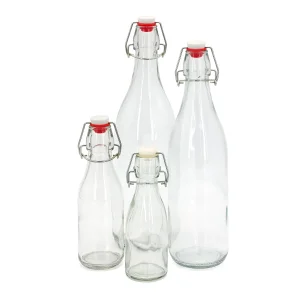
The classic swing-top closure, invented in the late 19th century, remains unmatched for consumer usability and structural sealing. Today’s top-tier manufacturers design and test these assemblies to withstand mechanical stresses from automatic cappers and hundreds of user cycles. High-tensile stainless steel wire bails prevent rust and bending under pressure, while food-grade silicone washers ensure consistent sealing force, keeping carbonation intact for up to 18 months.
Grolsch swing-top bottles use a spring-steel toggle lever clamp that applies continuous downward pressure on a food-grade silicone gasket. Unlike crown caps or screw caps, which rely on mechanical friction, the swing-top mechanism leverages physical tension to form a hermetic seal. This design easily handles pressures up to 12 Bar, ensuring long-term carbonation for beer, kombucha, and sparkling wines.
Quality control standards require glass containers to pass a temperature differential (thermal shock) test, typically specified as ΔT ≥ 40°C. During testing, bottles are heated in hot water baths and quickly transferred to cold water. Excellent raw materials and stress-free cooling inside the annealing lehr prevent cracking or structural failure during hot-fill or pasteurization cycles.
Yes, they are highly reusable due to the durability of soda-lime-silica glass. Before reuse, bottles must be sanitized. The wire bails and silicone gaskets can be washed at high temperatures (up to 120°C for silicone). However, strong chemical sanitizers containing chlorine must be monitored closely to prevent surface oxidation on wire bails.
Modern glass factories offer deep customization, including custom embossed logos, screen printing, color spraying, chemical etching (frosting), and hot foil stamping. For high-volume projects, custom molds can shape the glass with ergonomic grips, custom neck profiles, and unique bases while maintaining even wall thickness.
 Bogart Glass